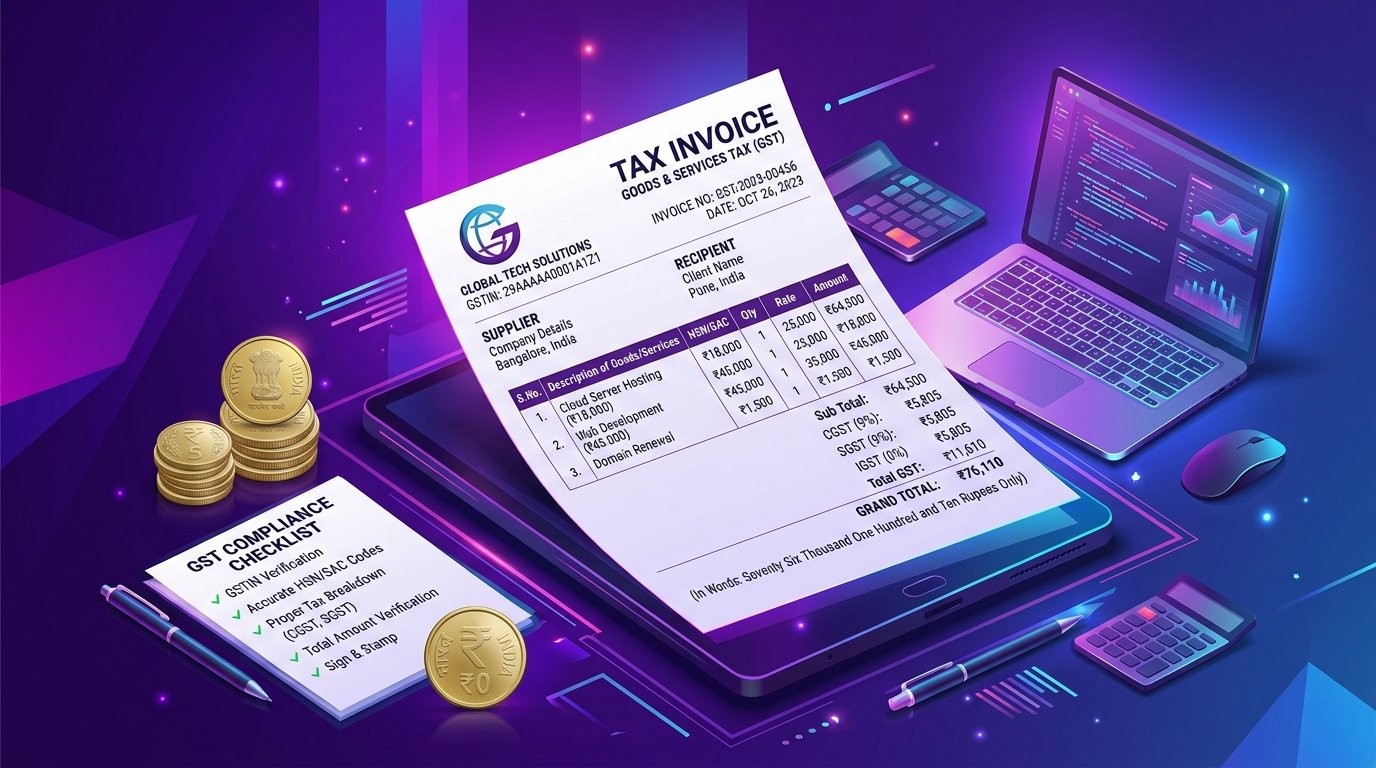
Creating a legally valid GST Tax Invoice in India requires adherence to statutory formatting mandated by Section 31 of the Central Goods and Services Tax (CGST) Act, 2017.
1. Mandatory Structural Elements Under CGST Rule 46
Every GST tax invoice issued in India must incorporate sixteen legal fields to remain valid during tax compliance audits.
These include the explicit header 'TAX INVOICE', supplier GSTIN, recipient GSTIN, consecutive alphanumeric serial numbers, date of issue, place of supply with 2-digit state code, itemized HSN/SAC codes, taxable values, and tax splits.
2. Intra-State vs Inter-State Tax Calculations
Determining whether to charge CGST + SGST or IGST depends on place of supply rules.
When supplier and buyer reside in the same state, split tax 50/50 into CGST and SGST. When they reside in different states, levy a single 100% IGST rate.
3. Frequently Asked Questions
What happens if an invoice lacks an HSN code?
Tax authorities may reject the buyer's Input Tax Credit (ITC) claim and penalize the supplier under Section 122.
4. Summary & Conclusion
Generate 100% tax-compliant GST invoices in under 60 seconds with InvoBill.